Central Texas Trailer Prep Scenario
Austin Trailer Restoration Case Study: Plan Rust Removal Right
Use this illustrative Central Texas scenario to coordinate trailer-frame preparation, repairs, weather, and primer without creating a bare-steel delay.
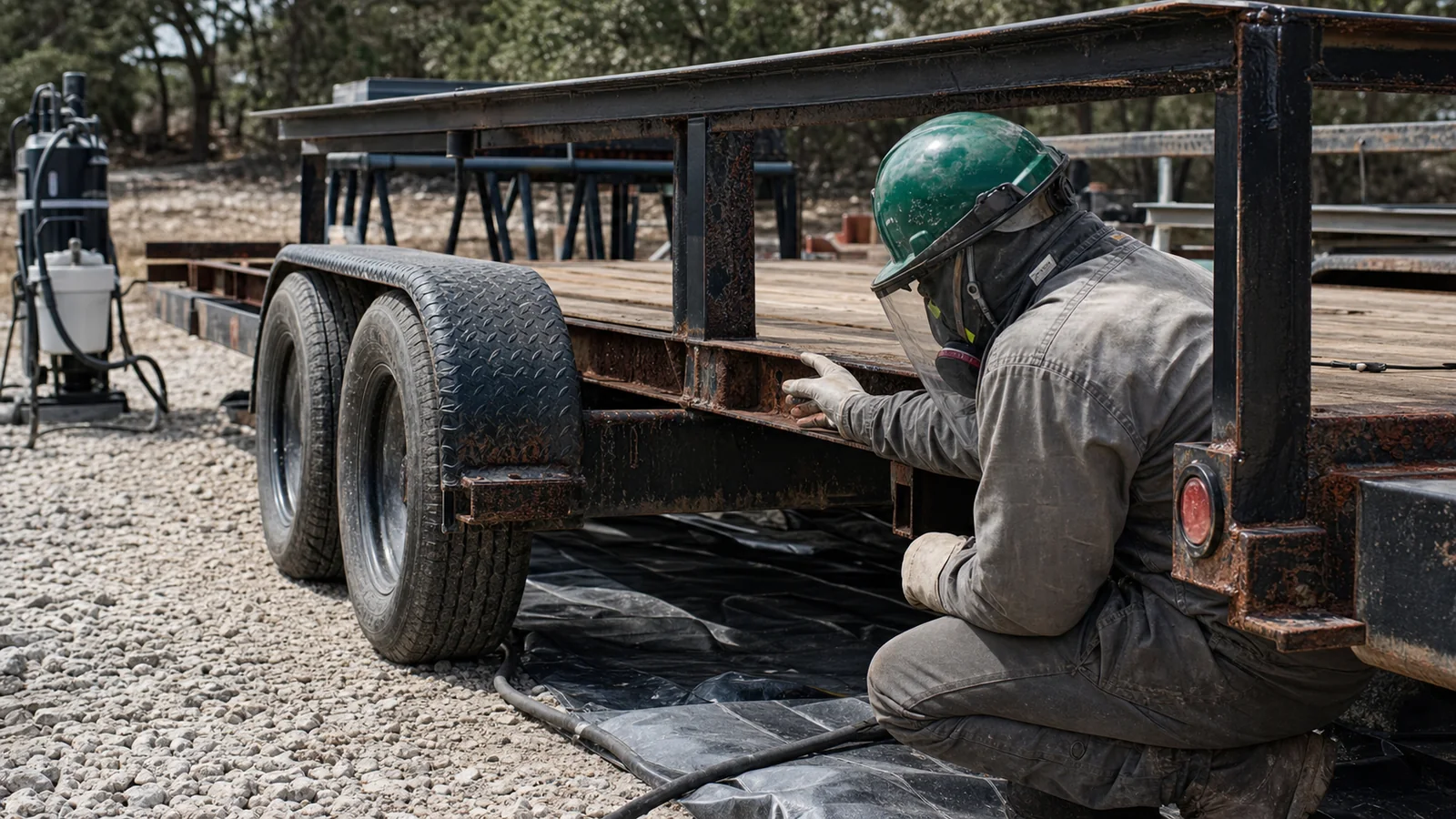
A Central Texas trailer can collect damage from road grit, jobsite mud, standing outdoors, loading impacts, and repeated wet-dry cycles. Once paint breaks at a weld, edge, ramp, or crossmember, corrosion can travel beneath adjacent coating. A fresh topcoat may hide the problem, but lasting restoration depends on removing unsound layers and coordinating what happens as soon as steel is exposed.
This article is an illustrative Austin trailer restoration case study, not a claim about a documented completed customer project. The legacy source describes a real-world type of workflow but provides no customer record, dated photographs, measured results, or inspection report. The scenario below translates that useful workflow into a Central Texas plan for owners, fleet managers, repair shops, and coating contractors.
Scenario: A Working Trailer With Failing Paint
Consider a utility trailer kept at a contractor’s yard in the Austin area. Paint is peeling along the frame, and corrosion is visible near rock chips, weld toes, inside corners, brackets, and the ramp. Mud has collected above several crossmembers. The owner wants the trailer prepared for repair, primer, and an outdoor topcoat—not merely washed for a better listing photo.
Before choosing a removal process, the team defines what “ready for primer” means. The painter may require all coating removed from designated areas, a particular surface profile, feathered transitions into retained sound paint, and a maximum acceptable level of flash rust. If that standard remains vague, the blasting crew cannot reliably deliver it.
The starting work package should include:
- trailer style, dimensions, asset number, and Austin-area location;
- wide photographs plus close views of edges, welds, rails, ramps, and underside;
- known age and type of existing coatings;
- visible oil, grease, mud, and severe pitting;
- components that require removal or protection;
- repair-shop and coating requirements; and
- weather, access, operating-hour, and deadline constraints.
Blasting may expose structural concerns, but it does not establish roadworthiness. Cracked welds, perforation, or meaningful section loss need evaluation by a qualified trailer repair professional.
Why Complex Trailer Geometry Changes the Scope
Flat, accessible rust spots can sometimes be handled with sanding or power tools. Trailer frames add overlapping members, crossmembers, channels, bolt holes, brackets, stake pockets, welds, and sharp transitions. Hand preparation becomes slow in those areas, and inconsistent removal can leave weak coating exactly where moisture returns.
Controlled abrasive blasting can improve access to irregular geometry that has a clear line of sight. It can remove selected failed coatings and corrosion products and create a surface profile suited to a compatible primer. It cannot reach every enclosed tube, lap seam, or blocked backside. Inaccessible locations should be identified rather than silently included in a broad “whole trailer” promise.
A combined method may be best: pre-wash or degrease, remove decking or hardware where justified, blast accessible frame sections, repair discovered defects, and power-tool or reblast repair zones. The project should be built around the required finish, not loyalty to one tool.
Plan Mobile Blasting Around an Austin Site
Bringing equipment to a yard can avoid hauling a disabled or partially disassembled trailer across town. Mobile work still requires a suitable operating area. Austin-area properties range from open contractor yards to compact commercial sites near neighbors, traffic, drainage inlets, and active crews.
A site review should address firm equipment access, hose routing, exclusion zones, wind, nearby vehicles, open bay doors, landscaping, storm drains, noise, and working hours. Wet abrasive blasting suppresses airborne dust compared with dry blasting, but it does not eliminate mist, rebound, coating debris, or spent media. Containment and recovery must match the coating, site, and applicable requirements.
Unknown coatings deserve special attention before disturbance. The trailer’s age does not prove what is in its paint. If hazardous constituents may be present, testing and an appropriate worker-protection, containment, and waste plan should come before mobilization.
Sensitive components need a written treatment plan. Lights, wiring, bearings, seals, brake equipment, hydraulic rods, tires, VIN and data plates, reflective markings, wood decks, machined faces, and threaded openings may need disassembly or robust protection. The owner and service provider should agree who performs and verifies that work.
The Illustrative Preparation Sequence
A disciplined sequence helps keep preparation connected to repair and coating:
- Inspect and document. Photograph condition, identify obvious defects, and agree on preparation boundaries.
- Pre-clean contamination. Remove packed soil, salts, grease, and oil through an appropriate cleaning step rather than driving them across the steel.
- Stage and protect. Immobilize the trailer, control access, disassemble agreed items, and establish containment and recovery.
- Test a representative area. Tune media, pressure, flow, nozzle distance, angle, and pass speed to the actual coating and steel.
- Prepare manageable sections. Work methodically across rails and crossmembers while giving welds, corners, edges, and brackets deliberate attention.
- Inspect exposed steel. Mark cracks, deep pits, thin areas, missed coating, and inaccessible locations for owner and repair-shop decisions.
- Complete repair and touch-up. Reprepare welds or altered areas as the coating specification requires.
- Clean, dry, and release. Verify the accepted condition and hand sections to the painter without an undefined outdoor wait.
The final surface should be assessed under agreed criteria, not by a dramatic color change alone. “Looks clean” does not verify anchor profile, soluble contamination, or coating compatibility.
Coordinate Austin Heat, Humidity, and Primer Timing
Central Texas weather can narrow the handoff window. Hot afternoons do not guarantee dry, coating-ready steel: morning humidity, sudden showers, condensation, and temperature swings all matter. Steel temperature can differ from ambient air, and a surface near the dew point should not be coated merely because the forecast appears clear.
Arrange the painter, primer, inspection tools, and protected workspace before exposing large areas. The coating manufacturer’s data should control acceptable surface condition, temperature, relative humidity, dew-point margin, application window, and cure requirements. Same-day priming is often a useful planning objective, but it is not a substitute for those instructions.
If the trailer must move between the preparation yard and paint shop, assign responsibility for transport and weather protection. Rain, road spray, dirty straps, bare hands, and shop delays can compromise a prepared surface. Smaller preparation sections may let the coating crew follow more reliably than blasting the entire frame faster than it can inspect and prime.
What This Planning Case Study Demonstrates
A successful preparation stage would leave designated accessible areas free of the specified failed coating and loose corrosion, with the required profile and condition accepted by the painter. It would also reveal hidden deterioration early enough for a repair decision. It would not promise that abrasive blasting repairs steel or guarantees a coating lifespan.
The strongest takeaways for Austin-area owners are:
- define the primer and preparation standard first;
- budget time for disassembly, cleaning, inspection, repair, drying, and coating;
- prioritize welds, edges, seams, brackets, and drainage traps;
- use a test area before committing to full production;
- plan containment for the actual property and coating debris;
- keep qualified repair personnel available for newly exposed defects; and
- reserve the primer handoff before the trailer becomes bare steel.
Coating longevity depends on the entire system: steel condition, design and drainage, preparation, contamination control, product choice, film thickness, application weather, cure, service conditions, and future impacts. Preparation improves the foundation; it cannot remove every cause of corrosion.
Frequently Asked Questions
Can Austin Mobile Surface Prep blast a trailer at my yard?
Mobile service may fit when the property provides safe access and enough room for equipment, hoses, exclusion, containment, and recovery. Photos and a site discussion help determine whether the location is workable.
Does dustless blasting mean there is no dust or cleanup?
No. Wet abrasive blasting reduces airborne dust compared with dry blasting, but mist, rebound, removed coating, water, and spent abrasive remain. Site controls and cleanup are still part of the scope.
Can the trailer be primed the day after blasting?
Possibly, but the correct interval depends on the coating specification, weather, contamination, and observed steel condition. Coordinate the handoff in advance and inspect again before primer rather than assuming overnight exposure is acceptable.
How can I get a useful trailer blasting estimate?
Provide wide and close photos, trailer dimensions, coating history if known, corrosion areas, desired endpoint, site ZIP code, access constraints, repair plan, primer requirements, and target dates. An on-site review or test area may still be needed.
Schedule a Central Texas Trailer Assessment
Send Austin Mobile Surface Prep photographs of the complete trailer and its worst rust, including the underside, welds, rails, ramp, and crossmembers. Add dimensions, the Austin-area ZIP code, known coating details, intended primer, repair-shop contact, and timeline. That information supports a meaningful scope rather than a guess based only on trailer length.
Call 512-592-1288 or email [email protected] to discuss mobile trailer surface preparation in Austin and Central Texas.
Suggested next reads:
Related Austin surface prep guides
Want a project-specific answer?
Send photos, the Austin-area location, approximate size, existing coating or buildup, desired finish, and timeline. We will help determine whether mobile wet abrasive blasting is the right fit.
Text Photos to (512) 592-1288