Automotive Restoration Planning
Classic Car Paint Removal in Austin: When Blasting Fits
Blasting can help a restoration when the component, coating, equipment settings, and handoff plan are right—but it is not the answer for every panel.
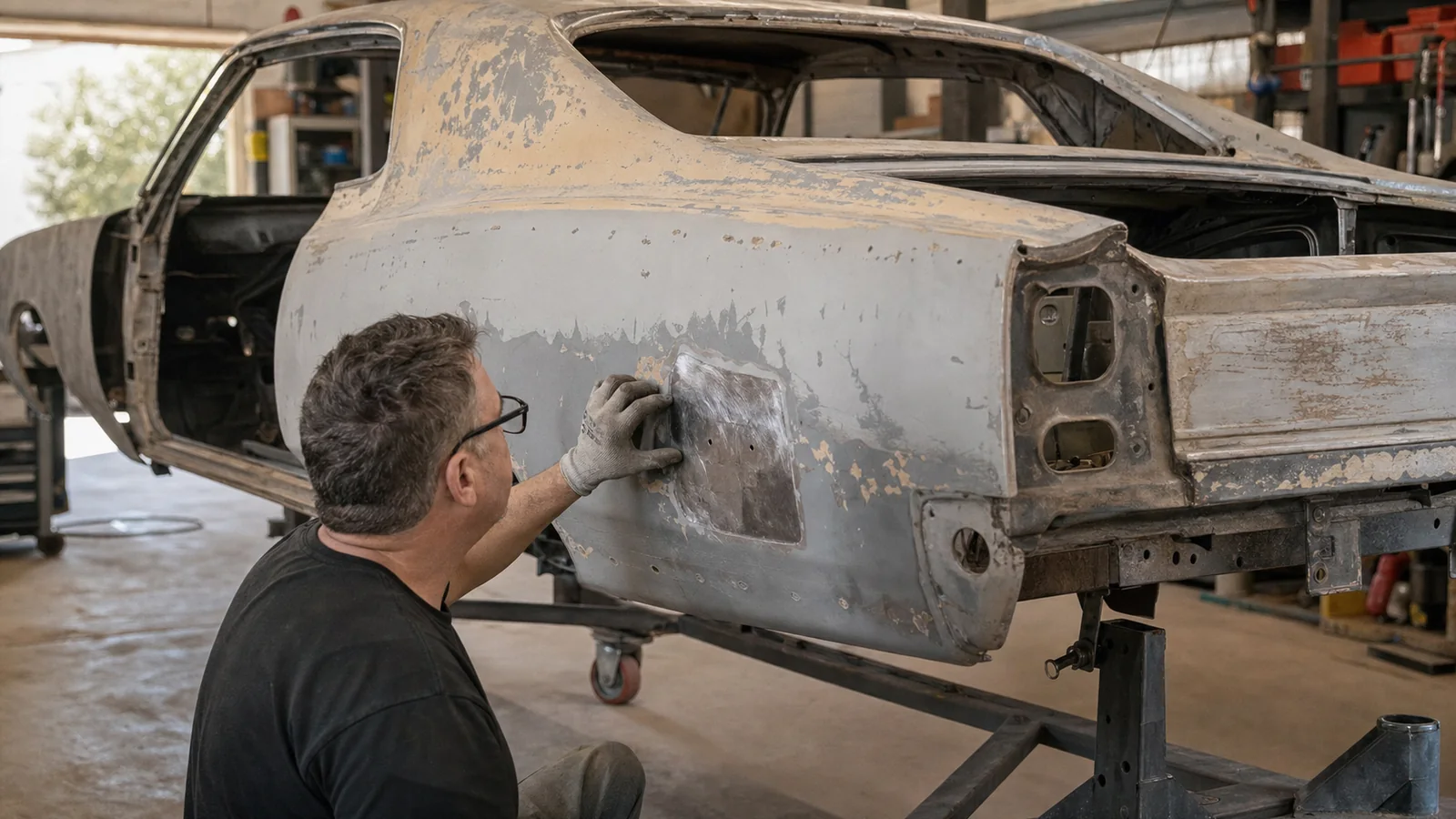
For a classic-car project, removing paint is not merely demolition before the “real” restoration. It is the stage that exposes prior repairs, corrosion, filler, stretched metal, pinholes, and seams that may shape everything that follows. Classic car paint removal in Austin therefore needs a method selected around the vehicle—not a blanket assumption that every body should be blasted.
Controlled abrasive blasting can be effective on suitable components and coatings. It can also damage thin sheet metal, leave media in cavities, or create a surface that does not match the restoration shop’s coating system if the process is poorly planned. The right question is not simply, “Can this car be blasted?” It is, “Which parts are appropriate, under what controls, and who owns each step after the coating comes off?”
Where Blasting Can Fit a Classic-Car Restoration
Blasting is often best evaluated component by component. Robust parts such as frames, axle housings, suspension pieces, brackets, and some wheels may tolerate a controlled process better than broad exterior skins. Even then, the operator must consider material thickness, casting condition, precision surfaces, bearings, threads, and areas that should be masked or disassembled.
A body shell combines heavier structural zones with flexible exterior panels. Treating them as one uniform substrate is risky. Corrosion and previous collision work further change how each area responds. A restoration plan may combine blasting with chemical stripping, sanding, or other methods.
Blasting can provide useful visibility by removing coatings and loose corrosion from complex geometry. It does not repair rust pits, replace weakened metal, correct distortion, or determine whether a questionable panel should be saved. Those decisions remain with the owner and restoration professionals after the surface is exposed.
When Blasting May Not Be the Right Fit
A method should be rejected or narrowed when the risk outweighs the access or speed advantage. Large, thin, low-crown exterior panels require special caution because they can distort. Fiberglass parts, delicate trim, leaded seams, soft solder, body filler, and mixed-material assemblies also need individual evaluation rather than default settings.
A complete or partially assembled vehicle introduces additional concerns. Abrasive can enter seams, rockers, braces, ventilation paths, regulators, and mechanical components. Media left in hidden cavities can emerge later during painting or vehicle operation. Glass, seals, wiring, bearings, machined surfaces, data plates, and threaded holes may need removal or careful protection.
Unknown coatings are another reason to pause. Paint age alone does not identify its composition. Suspected lead or other hazardous material should be assessed before disturbance and handled under an appropriate plan. If the owner cannot define disassembly, containment, cleaning, and immediate post-strip protection, the vehicle may not be ready for blasting.
Heat, Peening, and Panel-Warping Risk
Warping is often discussed as if heat were the only cause. Heat buildup matters, but mechanical stress from abrasive impact can also stretch or peen thin metal. Excess pressure, aggressive media, close nozzle distance, a direct angle, long dwell time, and repeated passes can all increase risk. A cool panel is not automatically an undamaged panel.
Good technique seeks to limit energy and exposure while still achieving the agreed removal endpoint. Operators may adjust media, pressure, flow, nozzle distance, angle, pass pattern, and work sequence. Moving continuously and avoiding prolonged focus on stubborn spots can reduce localized stress, but no responsible process should be presented as risk-free for every automotive panel.
Wet abrasive blasting reduces airborne dust compared with dry blasting and may help manage process heat, but it is not dust-free and does not eliminate distortion risk. Water also makes drying and corrosion control part of the plan. Technique, substrate condition, and restoration requirements matter more than the marketing label attached to the equipment.
Media, Pressure, and Testing Should Be Vehicle-Specific
There is no universal “classic-car setting.” Media that works well on a frame may be unsuitable for an exterior skin. Pressure at the machine is only one variable; media flow, nozzle size, stand-off distance, angle, coating toughness, and operator movement shape what reaches the panel.
A test area should be representative yet strategically chosen. On a disassembled project, an agreed hidden or replaceable area may reveal how the coating releases, whether filler or additional layers are present, and what surface texture remains. The owner and restoration shop should inspect the result before the full scope proceeds.
Testing does not turn a variable body into a predictable sheet. One fender may contain original metal while the opposite side hides repairs. The plan should allow work to stop when unexpected filler, severe pitting, brazing, thin metal, or distortion appears. “Remove everything at any cost” is rarely a sound instruction for a valuable restoration.
Plan the Handoff Before Bare Metal Appears
Freshly exposed steel can begin oxidizing quickly, and Austin humidity or changing weather can compress the available handoff window. Decide in advance who cleans, dries, inspects, and protects the surface. The restoration shop should specify its acceptable surface condition and compatible first coating rather than inheriting whatever profile the stripping method happens to produce.
Discuss seams and cavities explicitly. Water, media, paint fragments, and residue must be removed from drain paths and enclosed sections as far as the design allows. The coating shop may have requirements for blowing out, vacuuming, washing, metal treatment, masking, and final solvent cleaning. Those requirements should be reconciled before blasting, not discovered when the shell arrives for primer.
Transport matters as well. An open trailer, rain exposure, bare hand contact, or a delay at another shop can compromise prepared steel. If the blasting and coating locations differ, assign responsibility for weather protection, loading, transport, unloading, inspection, and schedule changes.
Coordinate the Owner, Blaster, and Restoration Shop
The owner should define the restoration goal: driver-quality refinish, preservation-minded work, bare-shell build, or targeted repair. The restoration shop should identify panels it wants stripped, areas it prefers left untouched, the desired profile, and how it wants previous filler or seam sealer handled. The blasting provider should explain practical access, masking, test strategy, containment, and stopping conditions.
Create a simple component list with instructions for the shell, removable panels, frame, suspension parts, wheels, and small pieces. Photograph items and identify fragile, rare, or irreplaceable details. Label parts that must not be blasted, including machined fits, identification stampings, glass channels, threads, and mounting faces where dimensions matter.
For an Austin-area assessment, send Austin Mobile Surface Prep wide and close photos, the vehicle’s location, the parts to be stripped, approximate body or component sizes, current disassembly status, known coating history, restoration-shop requirements, and target timeline. Call 512-592-1288 to discuss access and whether a test area makes sense. Early coordination helps prevent a clean bare shell from becoming a scheduling emergency.
FAQ About Classic Car Paint Removal in Austin
Can an entire classic-car body be dustless blasted?
Sometimes selected body areas may be appropriate, but suitability depends on panel thickness, shape, repairs, corrosion, disassembly, and the operator’s controls. A component-by-component review and test area are more responsible than assuming the complete shell should receive one process.
Does wet blasting eliminate the chance of warped panels?
No. Water can reduce airborne dust and help manage heat, but panel distortion can also result from mechanical impact and poor technique. Media, pressure, flow, angle, distance, dwell time, and the panel’s existing condition all matter.
Should the car be completely disassembled first?
The required disassembly depends on scope, but blasting an assembled vehicle risks media and moisture entering cavities and damaging protected components. Coordinate removal of glass, trim, seals, wiring, mechanical parts, and sensitive hardware with the restoration shop before work.
How soon should bare steel be primed?
The handoff should be arranged before stripping begins, with the restoration shop specifying inspection, cleaning, and coating requirements. Bare steel can oxidize rapidly depending on moisture and exposure, so avoid an undefined delay between paint removal and approved protection.
Related Austin surface prep guides
Want a project-specific answer?
Send photos, the Austin-area location, approximate size, existing coating or buildup, desired finish, and timeline. We will help determine whether mobile wet abrasive blasting is the right fit.
Text Photos to (512) 592-1288