Commercial Surface Preparation
Parking Lot Striping Removal in Austin: Plan for the Surface and the Repaint
Old parking lot markings do not come off the same way on every pavement. A practical removal plan starts with the surface, tests the result, and coordinates the next coating crew.
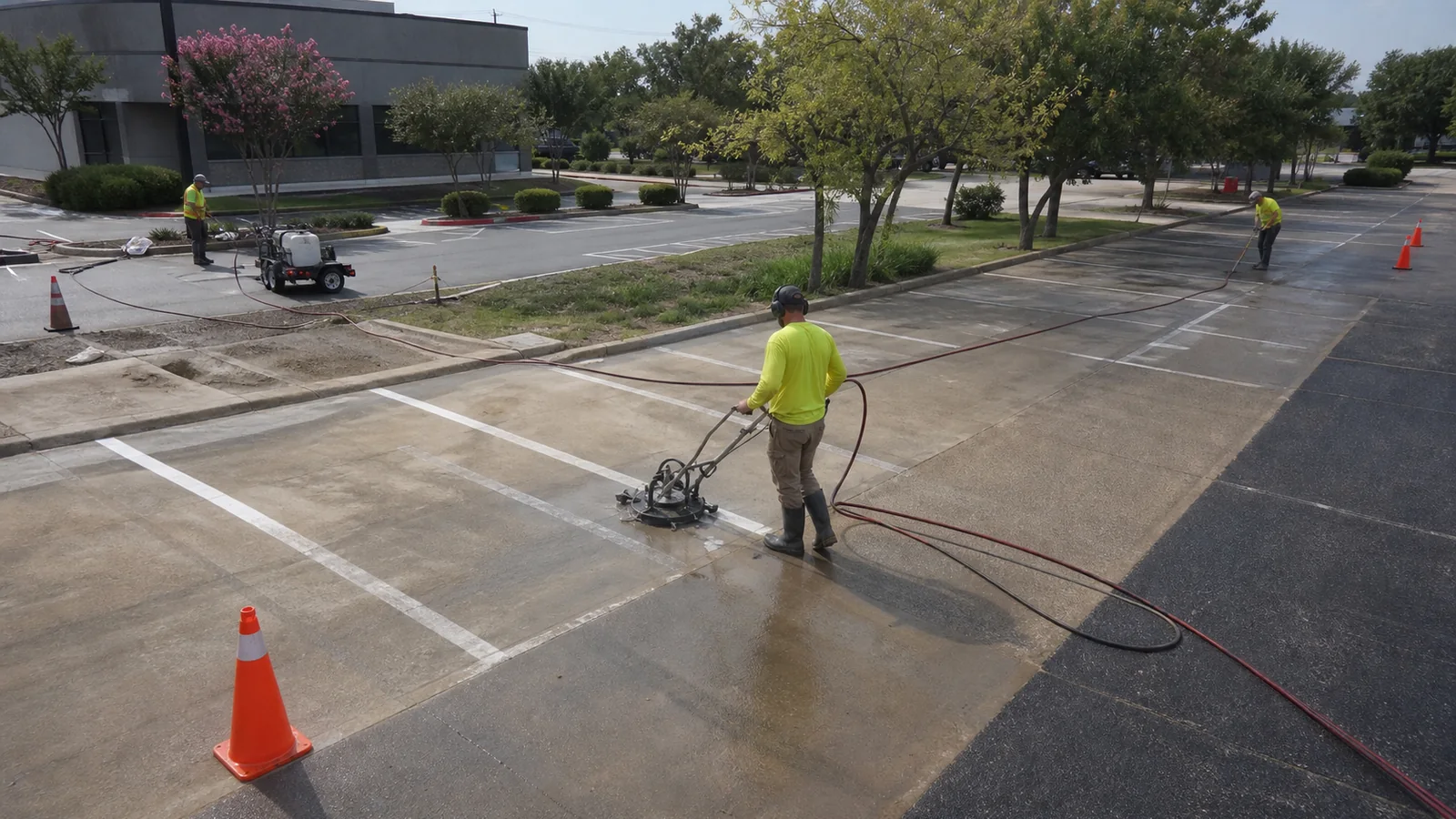
Old arrows, stall lines, curb markings, and traffic legends can create more than a cosmetic problem. When a commercial lot changes layout, the former pattern may confuse drivers or show through the new one. Effective parking lot striping removal in Austin is therefore not simply a matter of making paint disappear. The work must account for the pavement, the desired final appearance, active-site constraints, and the product that will be installed next.
Austin Mobile Surface Prep provides mobile dustless blasting and surface-preparation services for commercial properties across Austin and Central Texas. Wet abrasive blasting can reduce airborne dust compared with dry methods, but it is not dust-free. A site-specific plan should still address containment, runoff, debris, vehicles, pedestrians, and neighboring operations.
Concrete and Asphalt Require Different Decisions
Concrete is hard, mineral-based, and often capable of accepting a more aggressive preparation approach than asphalt. Even so, concrete varies. A smooth parking garage deck, broom-finished sidewalk, exposed-aggregate area, and previously coated loading zone can respond differently. Removing a thick marking may reveal a cleaner or differently textured “ghost” where the line protected the slab from traffic and weather.
Asphalt is a different substrate: its binder and aggregate can be damaged or noticeably altered by an approach that is acceptable on sound concrete. Excessive aggression may remove surface material, expose aggregate, or leave a scar that is more visible than the original marking. Fresh, aged, sealed, patched, and heavily oxidized asphalt also do not behave identically.
That distinction drives method, media, pressure, angle, dwell time, and expectations. The goal may be complete coating removal, reduction of visual confusion, or creation of a suitable surface for a compatible covering system. The property manager, removal contractor, and striping or traffic-coating installer should agree on that goal before production begins.
Start With a Representative Test Area
A test area is one of the most useful steps in parking line removal. It allows the team to see how the marking and pavement respond before committing to a large lot. The test should represent the actual work—not an unusually clean corner if most lines sit in traffic lanes, and not concrete if the larger scope includes asphalt.
Useful questions include:
- Does the coating release cleanly or remain in low spots and pavement texture?
- How does the exposed area compare with adjacent weathered pavement?
- Is the resulting profile acceptable for the next striping or coating product?
- Does asphalt lose fines or aggregate at the selected settings?
- What containment and cleanup are needed at production pace?
Owners should review the dry result when practical. Wet pavement can temporarily deepen color and mask contrast. If several coating types, pavement ages, sealers, or repair materials are present, more than one test may be appropriate.
Match Removal to the Next Traffic Pattern
The best scope begins with the new layout. A line being permanently abandoned may need a different visual outcome than a line that will be covered by a wider marking. Crosswalks, arrows, accessible-space symbols, fire-lane markings, and stall lines also carry different visibility and layout concerns.
Provide a marked plan or walk the site with the restriping contractor. Identify which markings stay, which move, and which must no longer direct traffic. This helps avoid removing useful reference points too early or preparing areas that will not receive new paint.
Blasting is one possible preparation tool, not an automatic answer for every line. The test and substrate condition determine whether it is appropriate. Wet abrasive work reduces airborne dust, yet nearby doors, parked vehicles, landscaping, drains, and pedestrian routes still require planning.
Coordinate the Restriping or Traffic-Coating Handoff
Removal is only one part of the system. The installer of the next striping paint, traffic coating, or deck system should define the surface condition it requires. Product data may address cleanliness, dryness, profile, concrete curing, moisture, prior coatings, surface temperature, and application windows. Those requirements take priority over a generic assumption that “clean pavement” is ready.
This handoff is especially important on parking decks and coated concrete. A traffic-bearing membrane or multi-layer deck coating is not the same as ordinary parking lot paint. Removing markings without understanding the underlying system could affect a layer that is intended to remain. In those areas, involve the coating manufacturer’s documentation and the qualified installer before selecting the preparation method.
After removal, the site may still require rinsing, drying, vacuuming, masking, repairs, primer, or another installer-specified step. Austin Mobile Surface Prep can prepare the agreed area, but the coating applicator should accept the surface and control final product application.
Build Site Logistics Around an Operating Property
Commercial lots rarely stop functioning. A workable plan divides the area into phases and establishes closures that account for equipment access, hoses, overspray, cleanup, and drying—not just the width of each painted line.
Before mobilization, document:
- Work zones and the sequence in which they will close and reopen
- Tenant, customer, delivery, emergency, and accessible routes
- Vehicle relocation and towing communication
- Water and power availability, if required for the selected setup
- Storm drains, landscaping, storefronts, and sensitive adjacent surfaces
- Work-hour, noise, lighting, and property-management restrictions
- Where removed coating, spent media, and wash water will be controlled
Cones and barricades should reflect actual site circulation. Night work can reduce traffic but may add lighting, noise, security, and dew concerns. Day work can simplify visibility while increasing heat exposure and customer conflicts. The right sequence depends on the property rather than a one-size-fits-all schedule.
Plan the Austin Project Before Equipment Arrives
Photos and measurements make an initial conversation more productive. Send close views of the coating edge and pavement, wider views of the traffic pattern, and images of patched, sealed, cracked, or coated areas. Include the property location, approximate line length or marked square footage, surface types, desired new layout, and target timeline.
For Austin and Central Texas commercial parking line removal, call Austin Mobile Surface Prep at 512-592-1288. Share photos, location, approximate project size, and timeline so the team can discuss test areas, access, containment, and coordination with your restriping or traffic-coating contractor.
Frequently Asked Questions
Can striping be removed from both concrete and asphalt?
Potentially, but they should not be treated as interchangeable. Sound concrete and asphalt tolerate different levels of abrasion, and each can vary with age, finish, repairs, sealers, and prior coatings. A representative test helps determine an appropriate approach and likely visual result.
Will the old line become completely invisible?
Not necessarily. Removal can expose pavement that differs in color or texture from the surrounding weathered area. Coating may also remain in pores, texture, cracks, or low spots. The test area establishes a realistic appearance before the larger scope proceeds.
Can new striping be applied immediately after removal?
That depends on the pavement, preparation process, weather, and new product’s requirements. The striping or traffic-coating installer should confirm cleanliness, dryness, profile, temperature, and any primer or waiting period before application.
Can the parking lot remain open during the work?
Many projects can be phased, but the active work zone must be isolated from vehicles and pedestrians. Access needs, equipment movement, cleanup, weather, and coating schedules all affect reopening. A site map and operations plan help define practical closures.
Related Austin surface prep guides
Want a project-specific answer?
Send photos, the Austin-area location, approximate size, existing coating or buildup, desired finish, and timeline. We will help determine whether mobile wet abrasive blasting is the right fit.
Text Photos to (512) 592-1288